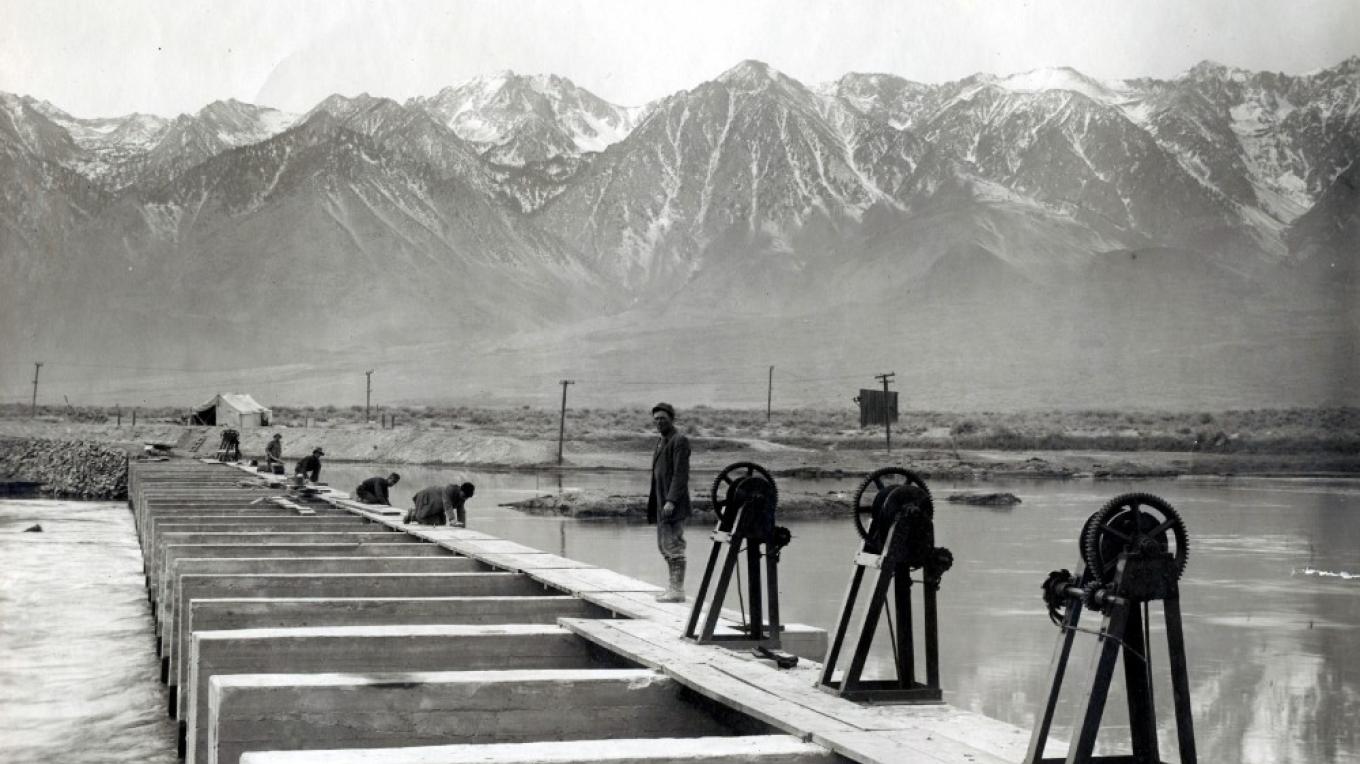
One of the reasons I say that La Cueva de Luz is a place "where history comes to light" is that the illuminated sculptures that fill it are literal metaphors for a storied part of Owens Valley history: I found all of the pieces of metal out of which I made those illuminated sculptures in dumps or "places of repose" on land belonging to the City of Los Angeles. And the story of how and why Los Angeles acquired that land is one of the more colorful and controversial chapters in what are known as the California water wars. Before Los Angeles acquired it, much of if not most of the land in the Owens Valley was devoted to agriculture, which supported the economy and influenced the culture of the region. But then the famous and infamous City Engineer William Mulholland figured out that the water upon which that agricultural economy was based - the water that flows every spring down into the valley from the melting snows of the Sierra Nevada - could be captured, put in an aqueduct, and transported 400 miles south to Los Angeles and used to grow its economy instead. Seizing that opportunity, the City of Los Angeles acting through Mulholland's Department of Water and Power acquired - some would say stole fair and square - most of the privately-owned land in the Owens Valley; not so much for the land but for the water rights to the land. And having become the colonial owner of those lands and water rights, LADWP predictably managed them solely to facilitate the export of water from the Owens Valley to Los Angeles. Which meant in practical terms that nearly all of LADWP's land in the Owens Valley would stay as is, undeveloped, as any development of the land would compete for and use its water. The irony of this is that while once and often still considered villains for taking water from the Owens Valley and drying it up economically and environmentally, it is likely that if LADWP did not own most of the land in it, the Owens Valley would look like much of developed California and not the vast open space we see today. In short, in taking the water, Los Angeles saved the land. And it was scattered about LADWP's open undeveloped land in various dumps large and small that I found the pieces of metal out of which I made the illuminated sculptures in the Museum. Those sculptures are thus a physical metaphor for this interesting and ironic episode in California history: had Los Angeles not acquired the land many years ago and kept it open since, those pieces of metal would have been long gone by the time I moved to Bishop in 1997. I never would have looked for or found them, and so never would have been inspired to make the sculptures in the Museum of Desert Lights.