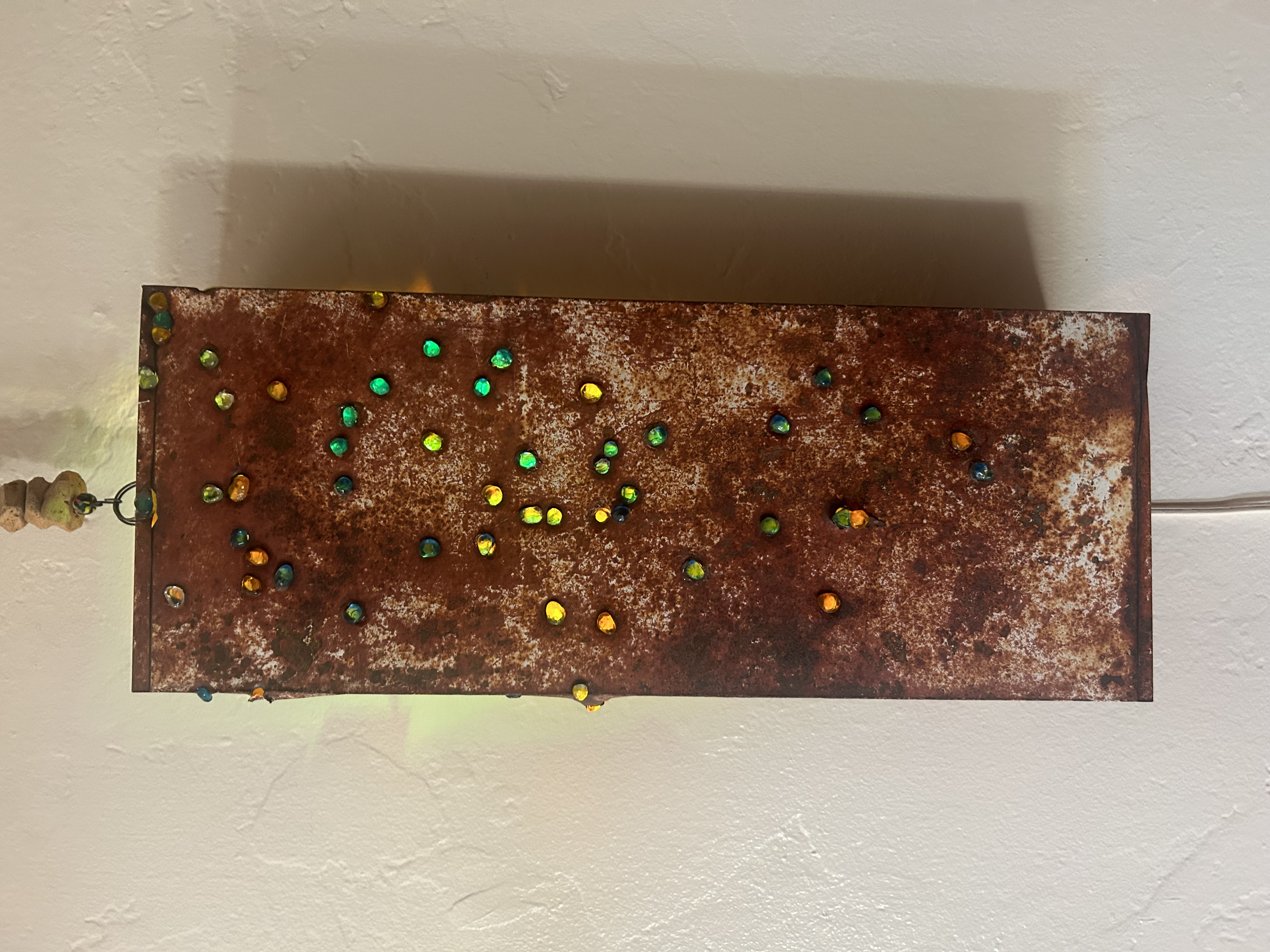
As history recounts and local land records show, for over a century, most of the land in the Owens Valley, including that around the City of Bishop, has been owned by the City of Los Angeles. The City - specifically its Department of Water and Power (LADWP) - acquired that land in order to secure the associated water rights, enabling it to transport the snow-melt water that every spring flows down from the Sierra Nevada over 300 miles south via an aqueduct to the ever-growing metropolis of Los Angeles. And over the course of those hundred years, various places on the LADWP's land were used as dumps upon which local residents threw away all manner of used-up metal objects - car and truck parts, pieces of machinery, oil cans, household items, etc. Although these pieces of metal sat exposed to the elements for decades, they did not deteriorate much. Rather, in the arid climate of the Owens Valley, they acquired a very thin layer of rust, a reddish-brown patina. It was about fifteen years ago, while exploring one of these old dumps, that I came across a piece of metal that interested me for some reason. It was rectangular, box-shaped, and although covered mostly with the patina of rust, still had on its surface some of the white paint applied when it was manufactured years ago. And as with many of the metal pieces I would later find and use to make sculptures, someone with a rifle had used this box-shaped piece of metal for target practice, and so it had a number of small randomly-placed holes in it. At this point what I can describe only as a divine spark of creativity struck me, for I was then compelled to try to make a decorative light out of the old metal box. Thus inspired, I took the box home, glued little blobs of colored glass called jelly beans over the holes, and hung a light bulb on a pendant socket on the inside of the box. I turned on the light, and voila! The light bulb illuminated the jellybeans covering the bullet holes, and the first of the illuminated sculptures in the Museum of Desert Lights was born. Having made one such light or sculpture, and knowing there were many more - hundreds even - of old patina-covered pieces of metal sitting out in LADWP's old dumps, I set about trying to find some that had holes or openings in them which I could cover and illuminate. I found several such pieces, but soon realized that while the jelly beans worked well covering small bullet holes, I needed a better medium to illuminate the larger holes in the pieces I found. Happily at this juncture I was again divinely inspired, for I discovered that I could create a perfect medium to capture the light by painting a piece of tracing paper on both sides with acrylic paint, slightly diluted with water. This made the tracing paper flexible, durable, and translucent. And of most utility, I found that if I put the painted tracing paper on the inside of the piece of metal rather than on the outside, I could illuminate all of the holes in the metal no matter how big or small or numerous. It is not an exaggeration to say that this revelation allowed me to create the illuminated sculptures that comprise the Museum of Desert Lights. And once having created most of those lights, I received what I feel was divine assistance a third time: as with most amateur artists, I had filled my home with the sculptures but, due to an unfortunate divorce had to sell it, causing me to confront the sad prospect of putting all of the sculptures in storage..But almost on cue - I truly believe with God;'s hand at play - the cave-like space at 174 West LIne Street in Bishop - the home of La Cueva de Luz - became available for rent. It was, is, and has been a perfect place for the Museum of Desert Lights to live and be on display for all to see and hopefully enjoy.